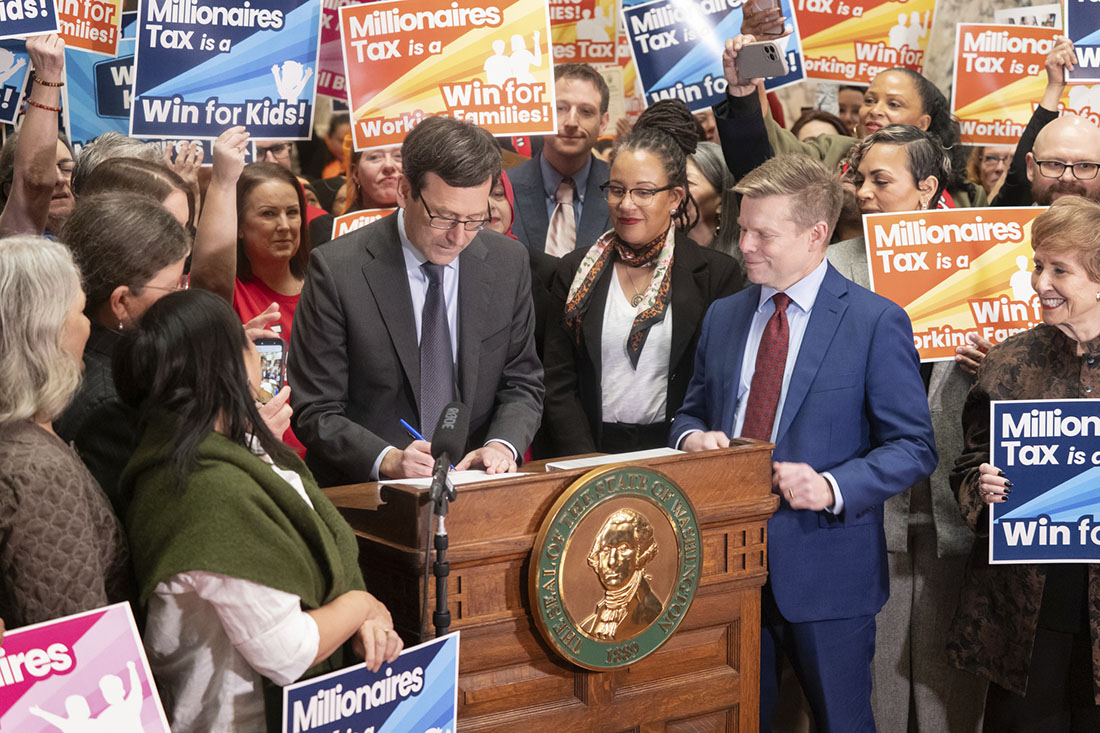
Governor Bob Ferguson signed Senate Bill 6346 on Monday, establishing Washington’s first personal income tax. The 9.9% levy on household income above $1 million takes effect January 1, 2028, with first payments due in 2029. It is expected to generate roughly $3 billion a year from approximately 21,000 taxpayers — less than 0.5% of Washington residents.
What the Tax Does
The levy applies to adjusted gross household income exceeding $1 million annually, with the threshold adjusted for inflation every two years. Roughly one-third of the estimated filers reside in the 41st, 45th, and 48th legislative districts in King County — high-income zip codes including Medina, Mercer Island, Bellevue, Redmond, and Sammamish, according to the state Department of Revenue. Washington had been one of nine states with no individual income tax. Voters previously rejected income tax proposals multiple times, most recently in 2010.
Among neighboring states, only Washington and Alaska had no income tax at all. Oregon and California both tax income starting from the first dollar earned, with top marginal rates of 9.9% and 13.3% respectively. Idaho charges a flat 5.3% at every income level, and Montana’s top rate is 5.65%. Washington’s new 9.9% rate matches Oregon’s top bracket but applies only above $1 million — meaning Washingtonians earning less than that threshold still pay no state income tax.
Where the Revenue Goes
The bill directs most of its proceeds to reduce the tax burden on lower- and middle-income residents. The largest single commitment expands the Working Families Tax Credit — a state-issued refundable credit ranging from $300 to $1,300 per year — from approximately 350,000 eligible households to 810,000. The bill also allocates more than $320 million toward affordable child care in the first full budget cycle, eliminating sales taxes on baby diapers, over-the-counter medications, and hygiene products. In its first full year, more than 41% of revenue raised returns directly to Washington families and small business owners, rising to 47% the following year, according to the governor’s office.
The Regressivity Context
Washington currently holds the second most regressive state and local tax system in the country, according to the Institute on Taxation and Economic Policy. Households in the bottom 20% of earners pay an effective state and local tax rate more than three times higher than those in the top 1%. Governor Ferguson cited a similar figure at the signing: families in the bottom 20% pay 13.8% of their total income in state and local taxes, while the wealthiest pay a substantially lower share.
The Legal Challenge
The Citizen Action Defense Fund filed suit the same day Ferguson signed the bill, arguing SB 6346 violates the state constitution’s uniformity requirement for taxation of property. Former Attorney General Rob McKenna, who leads the litigation, said: “Washington’s constitution is clear, and the courts have been equally clear for nearly a century — income is property, and progressive income taxes are unconstitutional under existing law.” This argument references a 1933 Washington Supreme Court ruling that invalidated a voter-approved income tax. Conservative political committee Let’s Go Washington simultaneously filed a referendum to repeal the law, though a “necessity clause” written into the bill blocks referendum challenges; the Secretary of State’s Office rejected the filing by the following day. Let’s Go Washington has indicated it may pursue an initiative — requiring roughly 340,000 valid signatures — instead.
What Happens Next
SB 6346 passed the House 51-46 and the Senate 27-21, with all Republicans and 11 Democrats opposing. The constitutional lawsuit is expected to advance toward the Washington State Supreme Court, which could hear the case before the tax’s 2028 effective date. If the court upholds the law, the first round of payments would be due in spring 2029. If it strikes the law down, it would mark the second time in Washington history that a voter- or legislatively-approved income tax has been invalidated by the state’s highest court.