Subscribe
  • Home
  • Metro Local News from the Pacific Northwest
  • About Mission, masthead, roadmap
  • Contact Tips, corrections, questions, technical support
  • Subscribe Get the latest in your inbox weekly
Metro Local News from the Pacific Northwest
Issue No. 024 April 20, 2026

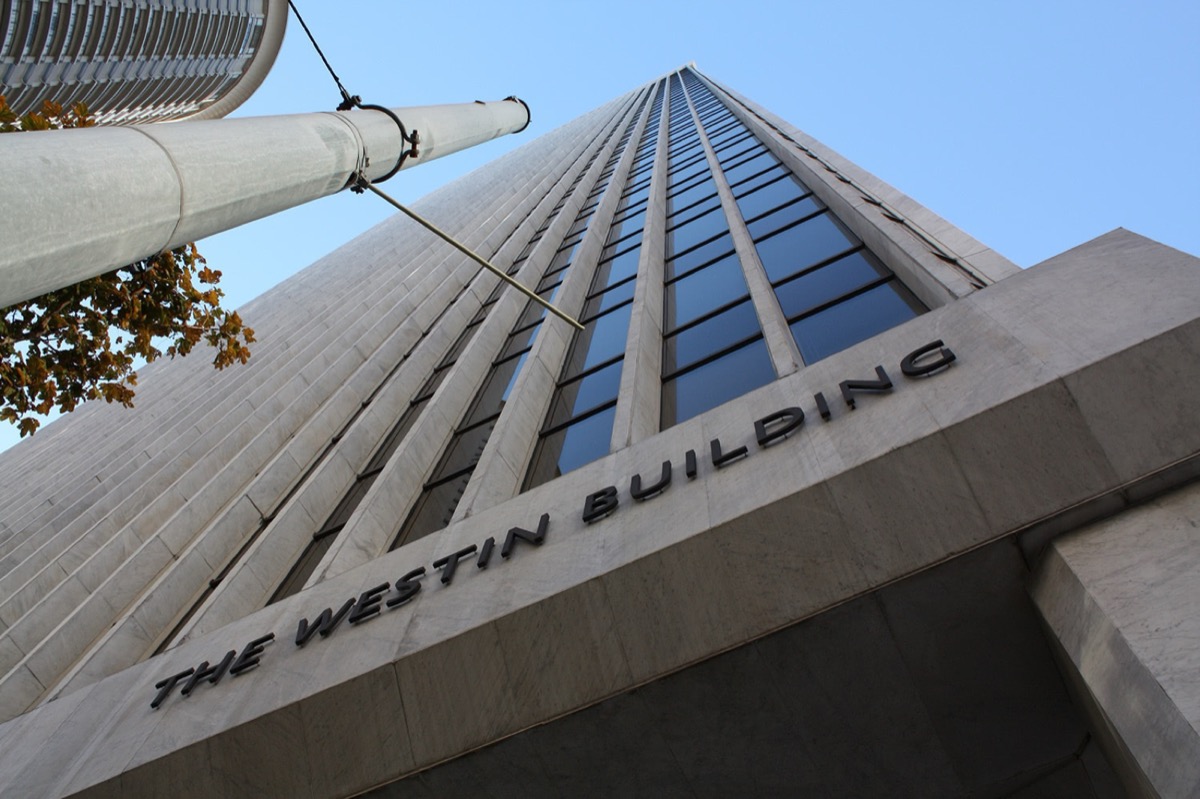
Photo: The Westin Building

Energy

Wilson Weighs Moratorium on Four New Data Centers

Three companies — Prologis, Equinix, and Sabey — are seeking Seattle City Light approval to build four large data centers with a combined peak demand of 369 megawatts, roughly one-third of the city’s average daily power use. Mayor Katie Wilson said Friday the city has not authorized any new facilities and is weighing a moratorium after more than 54,000 residents emailed City Council to support a pause. No permits have been filed; the four projects remain in a “cluster study” phase, an engineering review of whether the grid can deliver the requested load. At full capacity, the facilities would consume nearly ten times as much power as Seattle’s roughly 30 existing data centers combined.

What Seattle’s Data Centers Actually Look Like

The popular picture — a windowless warehouse on a suburban campus — is not what Seattle has. The city’s existing facilities are overwhelmingly small colocation operations inside downtown office buildings. The Westin Building at 2001 6th Avenue is the region’s primary carrier hotel: a 34-story tower hosting more than 200 telecom and internet providers, with Equinix SE2, DataBank SEA1, Digital Realty, and Colocation Northwest all operating racks across multiple floors. TierPoint runs space at Fisher Plaza in Lower Queen Anne; H5 Data Centers occupies 1000 Denny Way; phoenixNAP operates out of 2020 5th Avenue. These are racks and cages — footprints measured in tens of thousands of square feet, each drawing a few megawatts. The closest hyperscale campus sits just outside city limits: Sabey’s Intergate.Seattle in Tukwila spans more than a million square feet and about 54 megawatts — less than a sixth of what the four proposed Seattle facilities would draw together.

Where the Four Proposed Centers Would Go

City Light has declined to name addresses, citing nondisclosure agreements, but says all three applicants are looking at the “southernmost part” of its territory — the Duwamish industrial corridor through SoDo, Georgetown, and South Park, where heavy-industrial zoning, large parcels, and substation proximity make siting feasible. The applicants match that geography. Prologis is Seattle’s largest industrial property owner, with 165 buildings and 25 million square feet in the metro area; its Georgetown Crossroads facility at 6050 E. Marginal Way S. is a 590,000-square-foot three-story warehouse — the multistory urban-industrial format that translates readily to a dense-urban data center. Sabey already runs the Tukwila hyperscale campus and has decades of City Light experience. Equinix, a downtown colocation operator for more than twenty years, would be scaling up into an industrial format for the first time in Seattle.

Rate Pressure and the New Large-Load Policy

Seattle City Light customers are already absorbing a 5.4 percent rate increase in 2026 — about $4 more per month for a standard residential customer — with further increases projected in the years ahead. The utility faces billions in deferred infrastructure costs, including aging cable replacement and a Skagit River hydropower license renewal, and is absorbing rising load from new housing, EV adoption, and building electrification. Opponents argue adding 370 megawatts of industrial demand would worsen the squeeze on households. City Light is rewriting its contract terms: under the draft policy, any approved data center would have to secure its own power supply outside the city’s existing grid allocation and pay for all infrastructure upgrades at no cost to other ratepayers. “This cannot go back to the ratepayer,” said City Light executive Andy Strong. The revised contracts go to the mayor’s office within weeks.

What Happens Next

Council members Alexis Mercedes Rinck and Eddie Lin were independently exploring a moratorium before Wilson’s statement; none has yet been introduced. The mayor and Council will decide whether the new large-load contracts provide sufficient protection, or whether a formal moratorium ordinance is needed. Because no permit applications have been filed, any moratorium would halt proposals still in pre-application — a narrow but meaningful window.

Subscribe to Metro

Local News from the Pacific Northwest. Get it in your inbox.

    Headlines

    Seattle voters will decide an $480 million library levy in August —

    The City Council voted 8-0 to put a seven-year levy renewal on the August 4 ballot; at $163 per year on a median-value home, it would fund all 27 branches, seismic upgrades, and a rebuilt Columbia City branch.

    City of Seattle

    Washington awarded $56 million to expand child care as 1,800 pre-K slots were cut —

    The state Commerce Department distributed $55.9 million in facility grants to 74 providers this week, adding roughly 2,000 spots.

    Washington State

    Pierce County Council voted to withhold funding for the Tacoma light rail extension —

    The council refused to contribute its share of the Tacoma Link extension, adding political friction to Sound Transit's effort to close a $34.5 billion system-wide deficit before a board vote on the ST3 plan no later than June 30.

    Sound Transit

    Hundreds of undelivered King County ballots were found near a Renton dumpster —

    WA Republican Party Chair Jim Walsh said a constituent handed him a box of blank ballots discovered at a Renton strip mall; King County Elections has not confirmed the ballots are official and said the investigation is ongoing.

    Elections

    December flood victims sued King County over two levee breaches —

    Residents whose neighborhoods flooded after heavy rain in December filed suit against King County and the flood control district, alleging the breaches were preventable and that the county had prior notice of the levees' condition.

    King County

    China warned its citizens to avoid entering the U.S. through Sea-Tac Airport —

    The Chinese foreign ministry issued the advisory after approximately 20 visiting scholars were detained and denied entry at Sea-Tac by U.S. Customs; the warning targets a specific U.S. airport two months before Seattle hosts the World Cup.

    China

    Amazon agreed to acquire satellite operator Globalstar for $11.6 billion —

    The deal, Amazon's largest acquisition in years, sets up a 2028 launch of direct-to-device satellite internet — a direct challenge to Starlink and a potential boost to broadband access in rural Washington.

    Amazon

    US Navy seizes Iranian cargo ship in Gulf of Oman —

    The USS Spruance fired on and boarded the Iranian-flagged Touska on Sunday, capping a week that saw the US blockade of Iranian ports enter enforcement, Iran briefly reopen the Strait of Hormuz Friday before re-closing it Saturday after Revolutionary Guard gunboats fired on a tanker near Oman, and global oil prices swing from $102 to $87 to $95 a barrel.

    Iran War
    Weather

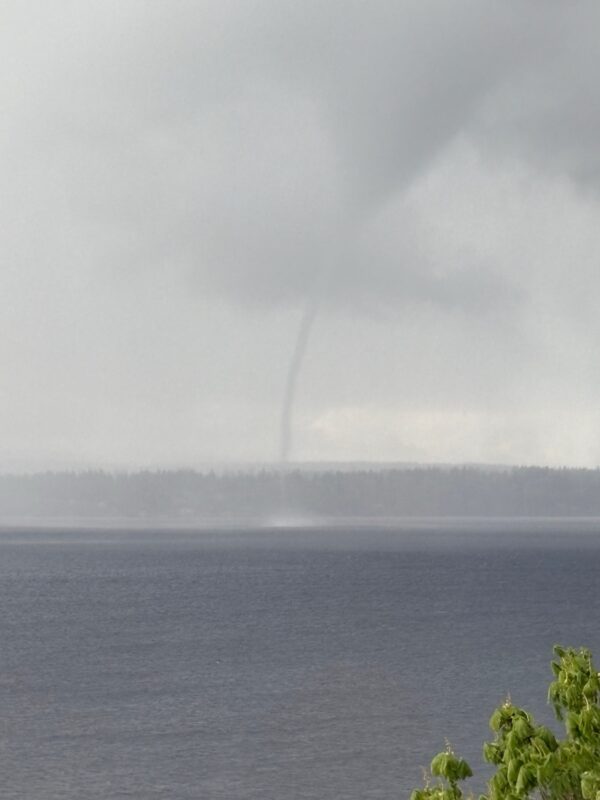
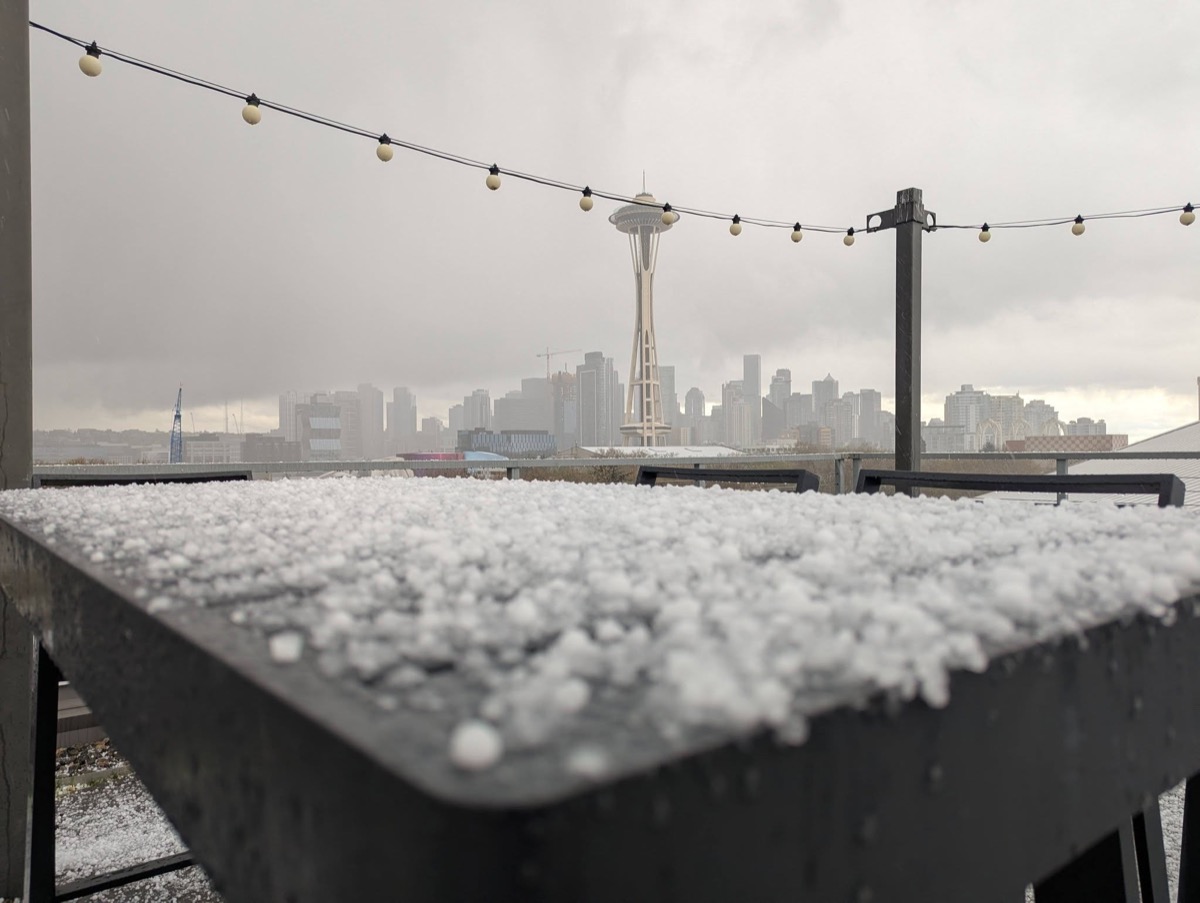
    Hail, Lightning, and a Water Spout (Oh my!)

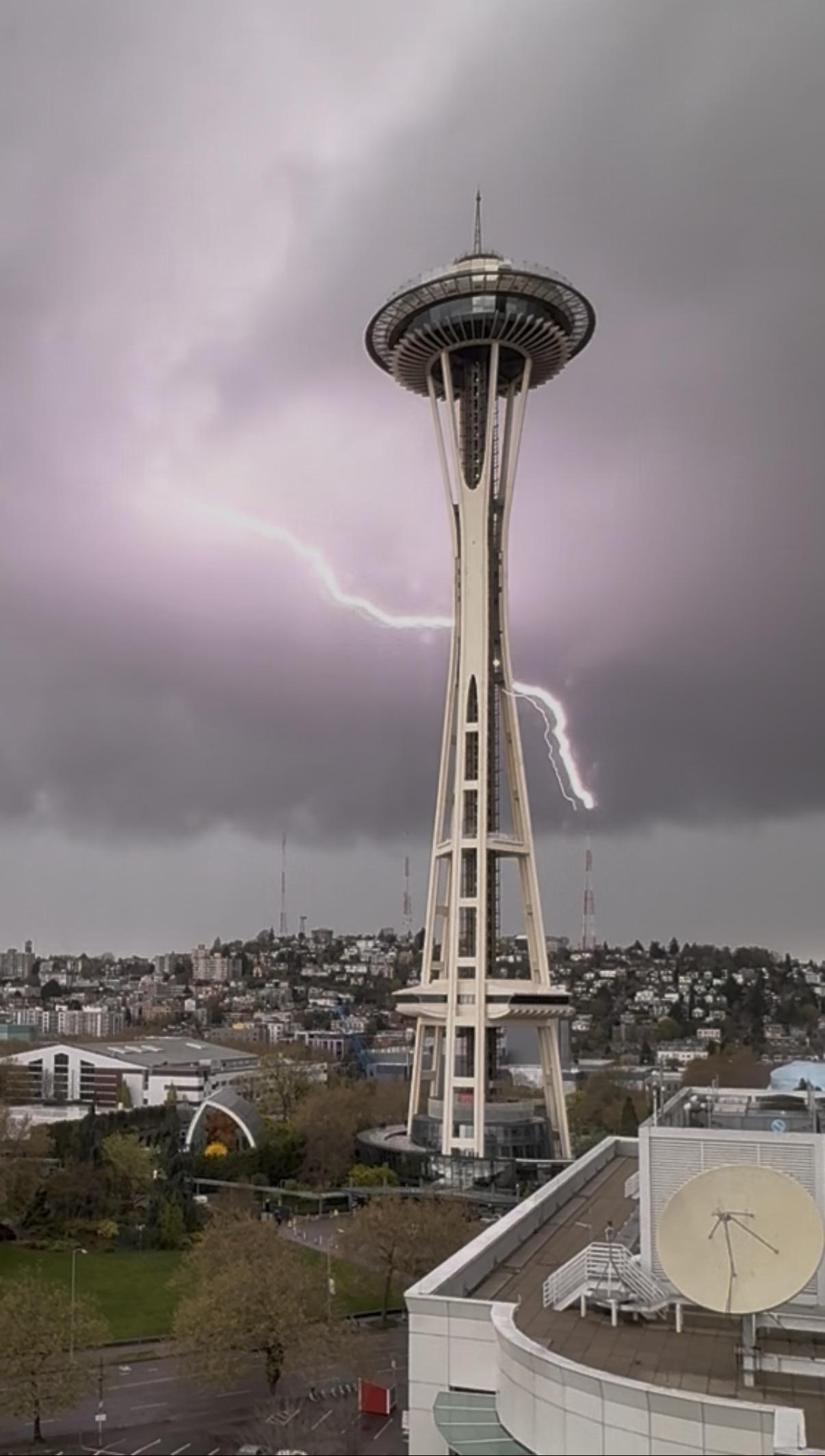
    Wednesday afternoon’s convergence-zone storm dropped hail on South Lake Union, put lightning over Queen Anne, and briefly spun a waterspout three miles west of Magnolia — the first April snow or hail recorded in Seattle since April 17, 1972, by Sea-Tac’s official measure.

    What Happened, and When

    The National Weather Service Seattle logged the waterspout at about 3 p.m., describing it as short-lived. Hail and graupel accumulated on rooftops through the afternoon; heavy downpours broke between stretches of blue sky; cloud-to-ground lightning struck above Queen Anne. Over the following 48 hours, the same system carried roughly 18 inches of fresh snow into the Cascades.

    Why It Happened

    The setup was a textbook Puget Sound convergence zone. Air splitting around the Olympic Mountains collided over the Sound, forcing upward motion. Cold air aloft sat over warmer surface water, and the instability produced the thunderstorm cell that carried the waterspout. “There is inherent rotation from the converging winds in a convergence zone,” University of Washington atmospheric scientist Cliff Mass wrote on his blog, “and that rotation can be increased by the strong vertical motion in a thunderstorm.” Weak tornadoes and waterspouts have a long history in this pattern, Mass noted — though they rarely come with April hail.

    Homelessness

    Seattle Expands Shelter as KCRHA Faces Forensic Audit

    The Seattle City Council unanimously approved two ordinances Tuesday advancing Mayor Katie Wilson’s shelter acceleration plan, directing millions in city funds toward the first 1,000 new shelter units Wilson has pledged to open by year-end. A third bill, expanding tiny house village capacity from 100 to 150 residents — with one pilot village allowed up to 250 — cleared committee Wednesday.

    What Was Approved

    The funding bill redirects money from the city’s affordable housing revolving loan fund and a downtown-restricted human services account toward shelter siting and operations. A separate leasing authority bill grants the Department of Finance and Administrative Services power to sign shelter leases and approve property improvements directly, bypassing a procurement process that city officials said added months to site development timelines.

    Council members attached amendments requiring monthly public safety reports from each shelter site, a September progress report on the 4,000-unit goal through 2029, and good-neighbor agreements with surrounding communities.

    The Interbay Site and What’s Next

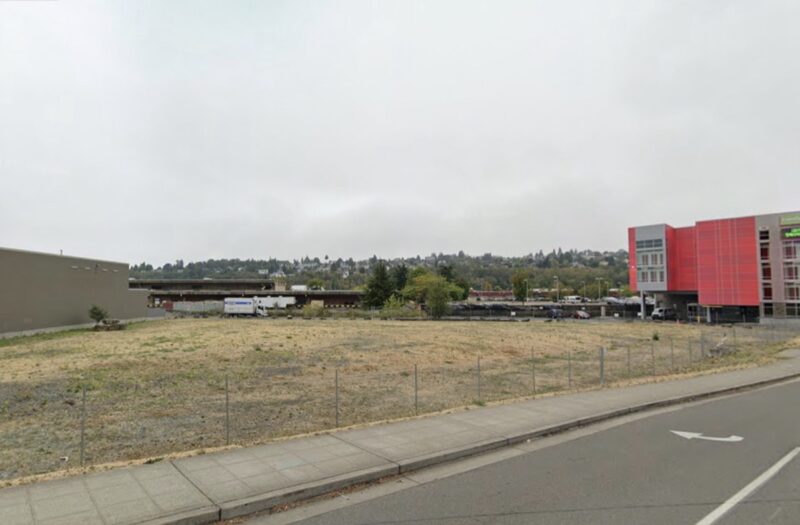
    The first confirmed site in Interbay — a parcel that had been planned for a commercial sports facility before the development was redirected. Individual micro-shelter units measure approximately 70 square feet. Immanuel Community Services will provide case management, mental health care, and substance use treatment. Additional sites are expected to be announced in coming weeks. The city is targeting 500 micro-shelters placed before June.

    KCRHA Audit and the City’s Independent Path

    The King County Regional Homelessness Authority will not oversee any of the new shelter contracts. The city’s Human Services Department will manage them directly — a departure from the regional model governing homeless services since 2021. Mayor Wilson’s office said the approach “make’s more sense for oversight and administration.”

    Separately, a $600,000 forensic audit of KCRHA commissioned by the city and King County is nearing completion. The audit covers the authority’s finances from 2021 through July 2025, examining fund use, recurring negative cash positions, and accounting practices. Results are expected this month.

    By the Numbers

    5.1%

    Washington’s unemployment rate

    The state’s jobless rate has now risen for four consecutive months, reaching a level not seen in years — and crossing above the national rate of 4.4% for the first time in recent memory. A year ago, the rate sat at 4.3%. Just 700 net jobs were added in February, the slowest growth pace of the post-pandemic recovery.

    8

    Citations issued in King County Metro’s relaunched fare enforcement program — all voided

    Between May and December 2025, Metro’s 30-officer fare enforcement team ($3.1 million annual budget) spent roughly 1,200 hours per week checking fares and issued exactly eight citations. All eight were thrown out for incomplete paperwork.

    27

    People killed in Seattle traffic in 2025

    Two-thirds were pedestrians. The Vision Zero program, launched in 2015 with a goal of eliminating all traffic deaths and serious injuries by 2030. Councilmember Saka has called for a performance audit of the program this week.

    Around Town

    Madison Valley

    PCC Community Markets is opening a 17th store this fall at 2925 East Madison Street — a decade after first signing the lease. Acting CEO Amy Chow said the project endured a “long road” through permitting and development. The co-op, which operates 16 locations across the Puget Sound region, will employ about 75 people at the new store. Construction is underway and the opening is targeted for fall 2026.

    Belltown

    A new walking and cycling path along the waterfront had its soft launch Friday and will hold its official grand opening Tuesday, April 21. The Elliott Bay Connections greenway runs 11 feet wide along the east side of Alaskan Way between Blanchard and Wall Streets, linking Pier 62 to the Olympic Sculpture Park — a stretch that previously forced cyclists into the active roadway whenever cruise ships blocked the protected bike lane at Pier 66. The trail features diagonal bike signals, water-view benches, and landscaping with reclaimed Puget Sound logs and oyster shells.

    Lake Washington Boulevard

    Nearly every summer weekend, Lake Washington Boulevard will go car-free from Memorial Day through Labor Day under an expanded Bicycle Weekends schedule Mayor Katie Wilson announced this week. The corridor between Mount Baker Beach and Seward Park — about 2.5 miles of lakeside road — will close to through traffic Friday evenings through early Monday mornings, with extended closures for Memorial Day, Fourth of July, and Labor Day weekends. The lone exception is the first weekend in August, reserved for Seafair hydroplane races.

    Columbia City

    The Columbia City Branch library is in line for a seismic retrofit under the $479.7 million library levy the City Council sent to the August 4 ballot this week. The branch, one of the system’s busiest, is the only location specifically earmarked for seismic work in the levy package — a $13 million line item in Mayor Wilson’s original $410 million proposal, preserved through council amendments that added $69.7 million to the total. Voters will decide in August whether to renew and expand library funding through 2033.

    Photos

    On the Web

    More than a year after Trump took office, tourists still haven’t returned to Point Roberts washingtonstatestandard.com

    Inside Trump’s Effort to “Take Over” the Midterm Elections propublica.org

    Jury finds that Live Nation acted as a monopoly and overcharged ticket buyers npr.org

    The race to sell Seattle hockey: Inside the Kraken’s 5-year struggle as NBA looms nytimes.com/athletic

    Employees at First-Ever Starbucks Store Seek to Unionize Amid Fight for Contract theguardian.com

    The West’s Snow Drought Meant Record Dryness — But Also Record Flooding hcn.org

    Quoted

    I share community concerns about environmental justice, economic resilience, and impacts of increased costs for Seattle rate payers.

    Mayor Katie Wilson

    In a written statement Saturday as her office weighs a moratorium on four proposed data centers whose combined power draw would equal roughly one-third of the city’s daily electricity use.

    ← Previous
    Issue No. 023 April 13, 2026

    © Metropoltica 2026. All rights reserved.
    Bring back the SuperSonics.

    UPC Code